Thursday, April 11, 2013

April 2013 ACA General Meeting

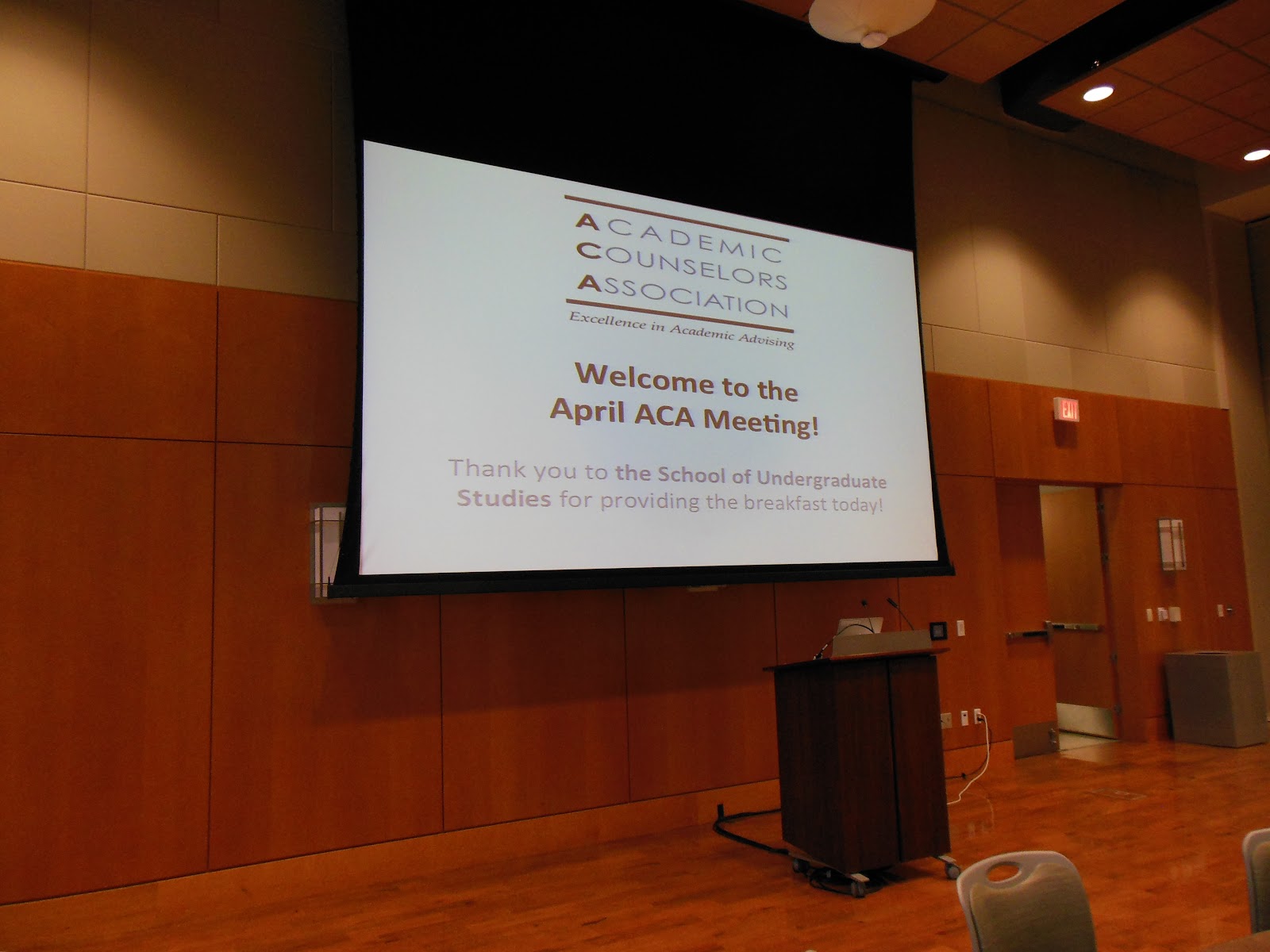
April social time was sponsored by the School of Undergraduate Studies.  Many thanks!


President Nathan Vickers and "Appreciating Campus Administrators" honoree David Spight of the School of Undergraduate Studies.  David took the opportunity to talk to ACA about the challenge of improving graduation rates at UT.  He emphasized that this is a chance for advisors to distinguish themselves as crucial to this mission.


Patty Micks of the Signature Course office in Undergraduate Studies spoke to ACA about summer and fall 2013 signature course offerings for first-year students (freshmen and transfers), and for students who are beyond their first year. 

Rebecca Wilcox from the Office of Undergraduate Research promoted the upcoming Research Week and urged advisors to attend and see the variety of research projects undergraduates are involved in.


Phaedra White of the School of Undergraduate Studies addressed ACA on a new initiative known as the Discovery Scholars Program, which will replace the Longhorn Scholars Program.  Current students will continue on with Longhorn Scholars until they graduate, but the incoming students for fall 2013 will be the first Discovery Scholars cohort, and they will all be from the School of Undergraduate Studies.  The program will continue to provide the same kind of advising and resources for this cohort that Longhorn Scholars enjoyed. 
From the Texas Success Initiative (TSI), Joe Schaub explained the state-mandated program of assessing reading, writing, and math for all students in all public colleges and universities in Texas.  Students without sufficient scores on the SAT, ACT or TAKS test will have bars on their records; between 200 and 500 students will come to orientation with a TSI bar and will have to prove their college readiness or take developmental course work. 

Kristen Tommey of Undergraduate Studies spoke briefly about Wayfinder and about the website's role in major exploration.  In particular, she discussed the new applicant portal that allows students considering UT to look at the all of the majors the university has to offer.  According to Kristen, 10,000 of the 30,000 students who applied to UT in 2012 accessed the site.

Julia Chinnock and the call for 2013-2014 ACA officer nominations!  Nominees will speak at the next ACA meeting on May 8.


Nathan Kinsman (left) and Uyen-Anh Dang discussed the A Community for Education (ACE) program.  ACE is an AmeriCorps program that works to improve early childhood literacy in Texas.  ACE employs tutors such as Uyen-Anh to go into the public schools and work with young children on their reading skills.  In return, tutors, who are recent college graduates, receive living allowances, loan forbearance, and at the end of their tenure, more than $5,000 that they can use to repay college loans or toward graduate school.  Currently, the program is hiring 90 new tutors. 

From Jane Shaughness of University Compliance Services: University Compliance Services is hosting, along with the UT Staff Council, UT Staff Ombuds, Human Resource Services, another in our very successful Employee Engagement series this year.  This May 6, 2013 (the first no class day) we will be hosting Robert Prentice, a faculty member in the McCombs School of Business and the founding member of the newly-created Business, Government, and Society department who will talk about “Why Good People Do Bad Things.”  The presentation will be held at 11:00 AM in AVAYA Auditorium.

And in honor of Dr. James Vick: http://www.longhornsp4p.com/

Wednesday, March 20, 2013

March 2013 ACA General Meeting

Thanks to the Study Abroad office for sponsoring the March social time!


 ACA President Nathan Vickers presents the "Appreciating Campus Administrators" award for March to Dr. Terri Givens of the Department of Government.

Jessica Miller (left) and Tanya Andrien spoke to ACA about the Undergraduate Energy Management Certificate Program.  This is a certificate program that mixes geology and business, and it is particularly appropriate for engineers, geologists, etc.  The program offers networking, workshops, and mock interviews.  They also offer a summer program.
Herpreet Singh from Undergraduate Studies provided ACA information on flags.  The goal is to implement all flags for all colleges in the 14-16 catalog.  Ms. Singh went on to discuss writing flags and petitions to attach flags to courses in transfer, among other topics. 
Dr. Lorraine Pangle discussed The Thomas Jefferson Center for the Study of Core Texts and Ideas (CTI).  Dr. Pangle is co-director of the Center.  According to Dr. Pangle, the focus of the certificate program is on great books (classical philosophy, texts of major world religions, political philosophy, American government) and new ways to study ethics, and is excellent for pre-law students.  Students can minor in CTI as well. 


Finally, Erik Funkhouser spoke to ACA about the UT Energy Symposium, an interdisciplinary speaker series on environmental energy.  Both undergraduates and graduates can earn course credit through this program.  Every week a speaker representing industry, government, or academia is brought in to address the symposium, and students get an opportunity to network with CEOs and government leaders.
Thereafter, the meeting adjourned.  


Friday, March 8, 2013

Member Spotlight: Joel Mendolusky

Hometown: Amherst, NH

College attended: The University of Texas at Austin


Degrees earned: BSCSD Communication Sciences and Disorders (1995), BA Psychology (1995) and English (2003)


Job Title: Senior Academic Advisor

Hobbies: Computer gaming, movies, reading

Current job at UT:  Advising psychology majors in the College of Liberal Arts

How many years worked at UT: I worked for three years as a work-study in the Graduate Office of the Department of Psychology and after a one-year hiatus, I was hired to replace my advisor, Laura Cole, in the Undergraduate Office for that same department in 1996.

Most challenging aspect of job: The most challenging, as well as most satisfying, aspect of advising is finding solutions to new problems.  With new, significant changes coming with each successive catalog, problems arise on a regular basis.

Favorite thing about current job: Advising students in psychology who want to pursue grad school, law school, medical school, you-name-it,  allows me to live vicariously through them as they pursue their dreams.  I get to help them make choices I did not myself make when I was in college.

Success story in current position: In nearly 17 years here at UT, I have never burst into flames (knock on fire-retardant wood).  I'm going to count that as a success.

Member Spotlight: Linda Mayhew

Hometown: Holmdel, NJ

College(s) attended: Kalamazoo College for undergrad and The University of Texas at Austin for graduate work.

Degree(s) earned: Kalamzaoo College, BA in English and Russian; University of Texas at Austin, MA and PhD in Slavic Literature and Languages.

Job Title: Academic Advising Coordinator.

What are your hobbies?  Horseback riding, cycling, and homebrewing.  I also like to work in my yard, crochet, travel, read, and cook.

What is your current job at UT? Advising Coordinator for Liberal Arts Honors and Humanities.  I also teach a class for our first-year honors students in the Spring.

How many years have you worked at UT?  I've worked full-time at UT since May 2005.  But before then I worked part-time in Athletics and as an Assistant Instructor and TA in the Slavic Department.

What is the most challenging aspect of your current job?  Time Management.  Sometimes there are so many things going on that I really need to plan my day out very carefully to make sure that I get everything done.

What is your favorite thing about your current job?  I wear a lot of different hats in my job and while that can be a challenge, I also love it. Aside from advising and teaching, I put together a biannual newsletter, plan several events like graduation receptions and the Humanities thesis symposium, read scholarship applications and help with admissions for Liberal Arts Honors.

Tell us about one of your success stories in your current position (regarding a student, co-worker, project, etc.)  Two years ago, I started the LAH Fall Bike Ride. Upper-class LAHers volunteered to lead small groups of first-year LAHers on bike rides around town – to Zilker Park, food trucks, Phil's burgers.  UT Orange Bike Project loaned bikes for the day to students who wanted to go on the ride and didn't have bikes on campus.  We had about 20 students participate in the ride, even though the ride took place in August and it was 97 degrees.  Another 12 students participated in a walk to Toy Joy and Spider House.  Everyone came back to our office for an ice cream party.  I was really excited about how the bike ride and walk turned out – our first years got a chance to meet some other LAHers, as well as find some places to eat and study near campus.

Wednesday, February 27, 2013

ACA February 2013 General Meeting


Thanks to the Study Abroad Office for sponsoring social time!
"Appreciating Campus Administrators" honoree, Deputy to the President, Dr. Charles Roeckle.   
Dr. Roeckle spoke briefly about his devotion to academic advising on campus, his years of service as a faculty advisor, and some of the advising initiatives with which he has been involved. 
Jen Morgan from Undergraduate Studies briefed ACA on changes to the Science and Technology portion of the university core for the 12-14 catalog.
Heather Barclay Hamir (top) and Rhonda Waller discussed updates from the Study Abroad Office.  They elaborated on their commitment to providing access to study abroad opportunities for traditionally underrepresented populations by reducing both financial and academic barriers (including grade point average).  Ms. Hamir, Ms. Waller, and their colleagues are working to integrate study abroad into every degree plan on campus in order to encourage study abroad while also complying with the four-year graduation rate initiative.  Study Abroad provides substantial funding; for academic year 2012-2013, they expect to award in the vicinity of $900,000 in travel scholarships.
Representing the Counseling and Mental Health Center (CMHC), Elizabeth Wilson spoke about the "Together>Alone" campaign to train students and other members of the UT community in suicide prevention.  Using skill building, role playing, and other techniques, CMHC raises awareness of resources and attempts to reduce the stigma associated with the issue.  Upon request, CMHC will conduct workshops in suicide prevention; the ACA ROAD Committee has just such a workshop scheduled for March 4 at 1:00 in CLA .122. 
Gina Gordon (left) and Dr. Gale Stuart spoke about the Student Engagement in the Research University (SERU) Survey.  The SERU Survey is intended for use on select research university campuses; it provides a "snapshot" of student experiences on such campuses, UT included.  The survey takes approximately 30 minutes, and the results allow campus administrators to "drill down" for information on items as specific as student feelings and opinions about their majors, about student "wellness," and much more, including assessment of advising.  SERU is essentially a campus "census."  This spring, the SERU administrators ask advisors' help in encouraging students to take and complete the survey. 

The meeting adjourned shortly thereafter. 

Thursday, January 31, 2013

January 2013 ACA General Meeting

Thanks to the Office of the Executive Vice President and Provost for sponsoring social time!


Appreciating Campus Administrators: Senior Vice Provost for Enrollment and Graduation Management, Dr. David Laude
Dr. Laude spoke to ACA about his affinity for advising, his experiences as a faculty advisor, and his view that every student is important.  He wants students to be part of communities that are inclusive and that enhance adjustment to life on a large campus.  Student success is his primary goal.  With that in mind, Laude will be piloting programs intended to aid in graduation rates, in retention, and, again, in maximizing student success.